
Foam Board vs Cement Board: Which Is Better for Tile?
When choosing a substrate for tile, the question is often not simply whether a material can support tile. Contractors also need to consider moisture exposure, weight, installation time, insulation, substrate preparation and the requirements of the complete wall system.
That is why foam board vs cement board is a common comparison for shower walls, bathrooms and other tile applications.
Both materials can be used as tile substrates, but they are built differently and offer different advantages. Foam-core boards can provide a lightweight, moisture-resistant solution with additional insulation, while cement board remains a familiar option for many tile installations.
So which one is better?
The answer depends on the project.
Table of Contents
Foam Board vs Cement Board at a Glance

Before looking at individual properties, the main differences can be summarized as follows:
| Feature | Foam Backer Board | Cement Board |
|---|---|---|
| Core | Typically rigid foam such as XPS | Cementitious material |
| Weight | Lightweight | Heavier |
| Moisture performance | Many products are designed for waterproof applications | Generally moisture-resistant; system requirements vary |
| Handling | Easy to carry and position | More difficult to handle because of weight |
| Cutting | Usually easy to cut | Typically requires more effort |
| Thermal insulation | Foam core can provide insulation | Limited insulation value |
| Tile substrate | Designed for many tile applications | Widely used as a tile substrate |
| Shower applications | Suitable when approved for wet areas | Commonly used in shower assemblies |
| Installation efficiency | Can reduce handling and cutting effort | Familiar installation method |
| Best suited for | Lightweight, moisture-sensitive and insulation-oriented systems | Traditional tile substrate applications |
These are general characteristics. Product specifications can vary significantly between manufacturers, so the specific board should always be checked before installation.
What Is Foam Backer Board?
Foam backer board is a lightweight panel designed to provide a substrate for tile and other finishes.
Many foam backer boards use a rigid closed-cell foam core, such as XPS, combined with reinforced surface layers. This construction can provide a combination of low weight, moisture resistance and thermal insulation.
For wet-area applications, the board can form part of the waterproofing system when it is properly installed and the joints, corners and penetrations are treated according to the manufacturer’s requirements.
A waterproof backer board with an XPS core can be used for applications including shower installations, tile underlayment systems and waterproof wall assemblies.
The main attraction of foam board is that it combines several functions in one relatively lightweight panel.
What Is Cement Board?
Cement board is a cementitious panel commonly used as a substrate beneath tile.
It has been used extensively in bathrooms, showers and other tile applications because it provides a stable and durable surface for tile installation.
However, cement board should not automatically be considered waterproof simply because it is commonly used in wet areas.
The Building America Solution Center recommends appropriate waterproof or moisture-resistant backing materials behind tiled shower and tub enclosures and notes the importance of moisture management within the wall assembly.
The waterproofing strategy therefore depends on the particular cement board, membrane, joint treatment and complete installation system.
Which Is More Waterproof?
This is one of the biggest differences between foam board and cement board.
Many foam-core backer boards are manufactured specifically as waterproof panels. Their closed-cell foam core has low water absorption, while the facing and edge details contribute to the overall system.
Cement board, on the other hand, is generally designed to tolerate moisture, but the board itself is not necessarily a complete waterproofing barrier.
This distinction is especially important in showers.
The Tile Council of North America explains that shower methods can use different combinations of backing and waterproofing materials, and the suitability of a particular combination depends on the manufacturers’ specifications and the design professional’s selection.
For that reason, the right question is not simply:
“Which board gets wet without failing?”
A better question is:
“Which complete system provides the required moisture protection for this application?”
Which Is Lighter?
Foam board has a major advantage when weight matters.
A rigid foam core is substantially lighter than a cementitious panel of comparable dimensions. This makes foam backer board easier to transport, carry and position during installation.
The difference becomes more noticeable on larger projects.
Consider a contractor installing tile in dozens of bathrooms. Even a small reduction in the weight of each panel can reduce the physical effort required to move materials around the jobsite.
This can also make one-person handling more practical in some applications.
Which Is Easier to Cut?
Foam backer board is generally easier to cut than cement board.
Depending on the product, installers can often make straight cuts using simple hand tools. This is particularly useful when working around:
- Pipes
- Shower valves
- Niches
- Electrical boxes
- Corners
- Fixtures
- Small openings
Cement board is also workable, but cutting generally requires more effort and can create more dust.
For renovation projects where installers need to make frequent cuts in confined spaces, the difference in handling can become significant.
Which Is Better for Shower Walls?
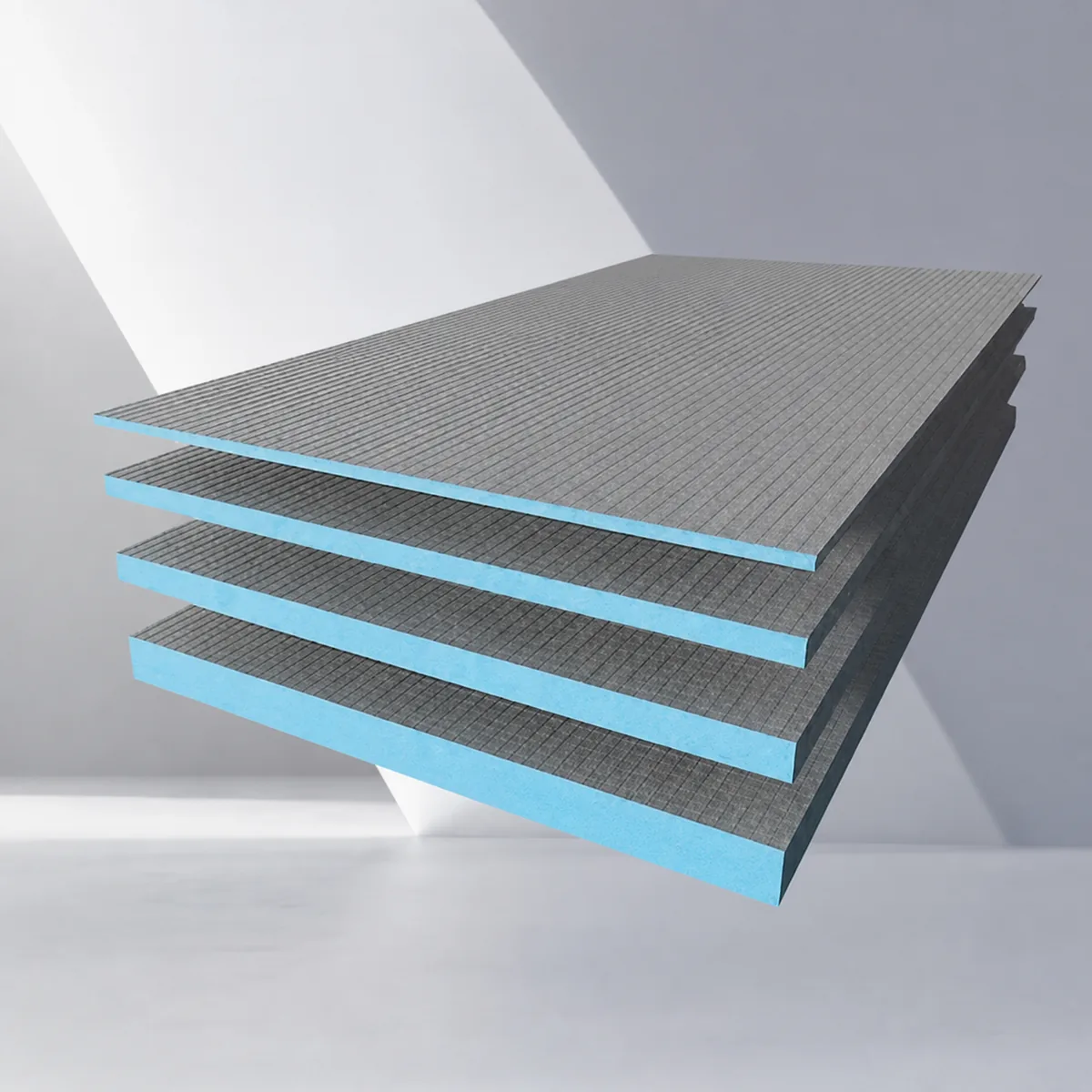
Both materials can be used in shower assemblies, but they work differently.
A foam-based waterproof backer board can be an efficient choice when the project prioritizes low weight, moisture resistance and installation convenience.
Cement board can also be used successfully when it is incorporated into a properly designed waterproofing system.
The Tile Council of North America’s current ANSI standards include provisions covering cementitious backer units as well as foam core backer boards and waterproof membranes.
This is important because shower performance depends on the complete assembly rather than the backer board alone.
For a detailed explanation of shower board selection, see our guide on how to choose the right shower backer board.
Which Provides Better Thermal Insulation?
This is another area where foam board can have an advantage.
Foam-core products can provide thermal resistance as part of the same panel that serves as a tile substrate.
That can be useful when the wall assembly requires additional insulation or when the project aims to combine multiple functions into one material.
Cement board has much less insulation value because of its dense cementitious construction.
For buyers considering XPS-based products, material specifications should be reviewed carefully. ASTM C578 establishes specifications for rigid cellular polystyrene insulation and covers properties such as thermal resistance, compressive resistance and water absorption.
The actual thermal performance of a finished backer board should always be taken from the manufacturer’s technical data rather than estimated from the core material alone.
Which Is More Durable?
Durability is more complicated than simply choosing the harder material.
Cement board is dense and rigid and has a long history of use in tile assemblies.
Foam backer board is lighter and less dense, but its performance depends on the foam density, facing materials, thickness, reinforcement and supporting structure.
A properly selected and installed foam board can provide reliable performance for many tile applications, but it should be installed according to its intended use.
For larger or heavier tile, the installer should pay particular attention to framing, fastening, substrate flatness and the manufacturer’s tile-size recommendations.
How Does Installation Compare?
Installation efficiency can be a major factor in the overall cost of a tile project.
| Installation Task | Foam Backer Board | Cement Board |
|---|---|---|
| Carrying panels | Generally easier | More physically demanding |
| Cutting | Usually simple | Requires more effort |
| Positioning | Lightweight | Heavier |
| Fastening | Depends on product system | Established fastening methods |
| Joint treatment | Product-specific | Product-specific |
| Waterproofing | Some products integrate waterproofing | Often requires additional waterproofing strategy |
| Jobsite handling | Convenient for many projects | More demanding |
| Large project efficiency | Potentially high | Depends heavily on labor setup |
The time savings from lightweight materials can become especially relevant when contractors are completing multiple bathrooms or wet areas within a short construction schedule.
What About Tile Adhesion?
The surface of the backer board matters just as much as the core.
A tile substrate should provide a surface compatible with the recommended mortar or adhesive.
Different foam boards use different facing materials, so installers should not assume that every foam board has identical adhesion characteristics.
The same applies to cement boards.
The Tile Council of North America’s 2026 ANSI publication covers recognized standards for ceramic tile installation and installation materials, while its standards list specifically includes A118.18 for foam core backer boards.
Before installation, always confirm the recommended adhesive, mortar and tile types for the selected board.
Foam Board vs Cement Board for Commercial Projects
The choice can be even more important on commercial projects.
Hotels, apartment developments, hospitals, fitness facilities and other projects may involve hundreds of tiled wet areas.
In these situations, material weight and installation efficiency can have a direct effect on labor requirements.
A lightweight foam board can be attractive when installers need to move large numbers of panels through a building.
Cement board may remain appropriate where project specifications, installer familiarity or specific substrate requirements favor a cementitious system.
For project buyers, the decision should include more than the unit price.
Consider:
- Material cost
- Waterproofing components
- Labor
- Handling
- Cutting
- Waste
- Transportation
- Installation time
- Technical support
- Supply consistency
Which One Should You Choose?
The answer depends on the priorities of the project.
| If Your Project Prioritizes… | Consider |
|---|---|
| Low panel weight | Foam backer board |
| Easy handling | Foam backer board |
| Integrated waterproofing | Waterproof foam board designed for this purpose |
| Thermal insulation | Foam-core backer board |
| Traditional cementitious substrate | Cement board |
| Familiar installation methods | Cement board |
| Large-volume bathroom installation | Evaluate lightweight foam board for handling efficiency |
| Heavy or specialized tile | Follow the specific board and tile system requirements |
For shower and wet-area projects where low weight, waterproofing and insulation are important, a foam-core waterproof backer board can offer several practical advantages.
For projects based around conventional cementitious substrates, cement board may remain a suitable choice.
The important point is to compare complete systems, not just individual boards.
What Should Contractors Check Before Choosing?
Before ordering either material, review the following:
Moisture Requirements
Determine how much water and humidity the finished wall will encounter.
Tile Requirements
Check the size, weight and type of tile planned for the project.
Wall Structure
Make sure the framing and substrate can support the board and finished tile.
Installation Method
Review cutting, fastening, joint treatment and waterproofing requirements.
Product Specifications
Check thickness, dimensions, density, water absorption, strength and thermal performance where relevant.
Accessories
Confirm which screws, tapes, sealants, membranes and other components are compatible with the board.
Local Requirements
Project specifications and applicable building requirements may affect which materials and installation systems are acceptable.
Common Mistakes When Comparing Foam Board and Cement Board
One mistake is comparing the two materials only by purchase price.
The board may represent only part of the installation cost. Labor, waterproofing materials, cutting, transportation and waste can all affect the final project cost.
Another mistake is assuming that every foam board or every cement board has the same performance.
Products differ in thickness, density, reinforcement, facing and intended application.
It is also a mistake to assume that the backer board alone determines whether a shower is waterproof.
A successful shower assembly requires appropriate treatment of seams, corners, penetrations and transitions.
Final Thoughts
When comparing foam board vs cement board, there is no universal winner.
Cement board remains a proven tile substrate, while foam backer board offers advantages in weight, handling, moisture management and thermal insulation when the product is designed and installed for those purposes.
For shower and wet-area projects, the most important decision is to choose a complete system that matches the moisture exposure, tile requirements, wall structure and installation conditions.
If lightweight construction and integrated waterproofing are priorities, an XPS-based waterproof backer board may be worth considering as an alternative to traditional cement board.
FAQ
Is foam board better than cement board?
It depends on the project. Foam board is generally lighter and can provide insulation and waterproofing benefits, while cement board is a traditional, durable tile substrate.
Can foam board be used for shower walls?
Yes. Foam backer boards designed and approved for wet-area applications can be used on shower walls when installed according to the manufacturer’s requirements.
Is cement board waterproof?
Not necessarily. Cement board can tolerate moisture, but whether it forms part of a waterproof assembly depends on the specific product and waterproofing system.
Which is easier to cut, foam board or cement board?
Foam board is generally easier to cut and handle, while cement board typically requires more effort and suitable cutting tools.
Does foam board provide insulation?
Yes. Foam-core backer boards can provide thermal insulation in addition to functioning as a tile substrate.
Can you tile directly over foam board?
Many foam backer boards are designed for direct tile installation with compatible mortar or adhesive. Always follow the product manufacturer’s instructions.
Is foam board strong enough for tile?
Properly selected foam backer boards can support tile when installed over suitable framing or substrate and used within the manufacturer’s specified application limits.
Which is better for large tile?
The answer depends on the specific tile, board and supporting structure. Large-format tile requires particular attention to substrate flatness, rigidity and installation requirements.
Does foam board cost more than cement board?
The material price can vary by product and market. Total project cost should also account for labor, waterproofing, handling, cutting and installation time.
How should I choose between foam board and cement board?
Compare the project’s moisture exposure, tile requirements, weight, insulation needs, installation method, specifications and total installed cost before making a decision.